

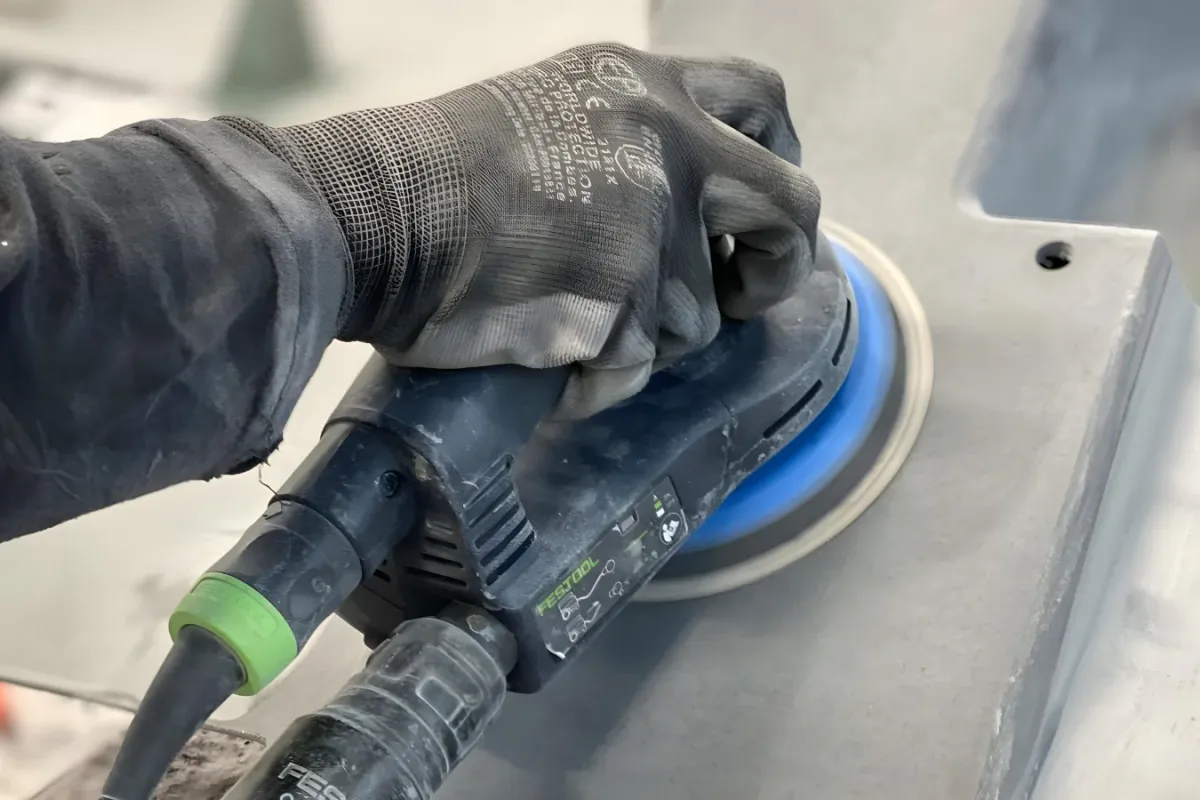
Industrial Surface Finishing and Painting
Surface finishing and painting is the final yet critically important step that determines a part’s ultimate appearance, durability and functionality. Carbon Composites Ltd.’s modern paint shop and experienced team guarantee that our products meet the strictest automotive, railway and aerospace standards, whether it is a matt industrial coating or a high-gloss decorative finish.
Surface finishing of plastic and composite parts requires specialised expertise that differs significantly from metal painting. Different polymers have varying surface energies, adhesion properties and heat tolerances, demanding customised pre-treatment and painting processes. In our facility, we apply optimised processes for each material type.
Painting is not merely an aesthetic function: it provides protection against UV radiation, chemicals, mechanical wear and weather. In certain applications it also delivers special properties, such as conductivity for EMC shielding, or fire resistance for railway vehicles. Our complex coating systems meet all of these requirements.
Our capacities
Painting Technology
For information on pre-treatment processes, 2K polyurethane chemistry, layer structure, Class A surface physical parameters, heat treatment and special coatings, see the painting technology guide.
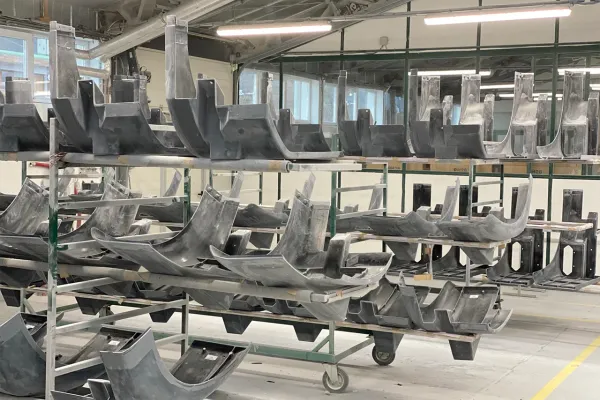
The paint shop is an integral part of our production chain. Parts arrive here directly from RTM production or PU-RIM production via CNC trimming – no transport damage, no communication loss. Painted parts become installation-ready products at the assembly department.
Our Painting Equipment
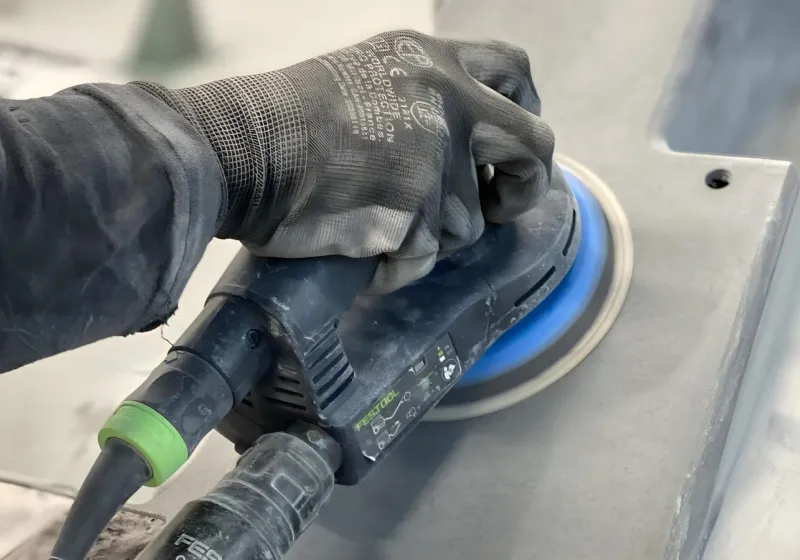
Spray Booths (2 units)
Dust-free, climate-controlled spray booths for automotive Class A surface quality. We work at controlled temperature (20–25°C) and humidity (60–70% RH), which is critical for 2K polyurethane systems. We paint with Sikkens (AkzoNobel), Glasurit (BASF) and Standox (Axalta) premium paint systems.
- Automotive Class A surface quality (OEM level)
- RAL, NCS, Pantone and custom manufacturer-specific colour codes
- Metallic, pearlescent and special effect paints
- Four-layer system: adhesion primer, filler, base, clear coat
- HVLP spraying for minimal material waste
- Two booths for parallel work
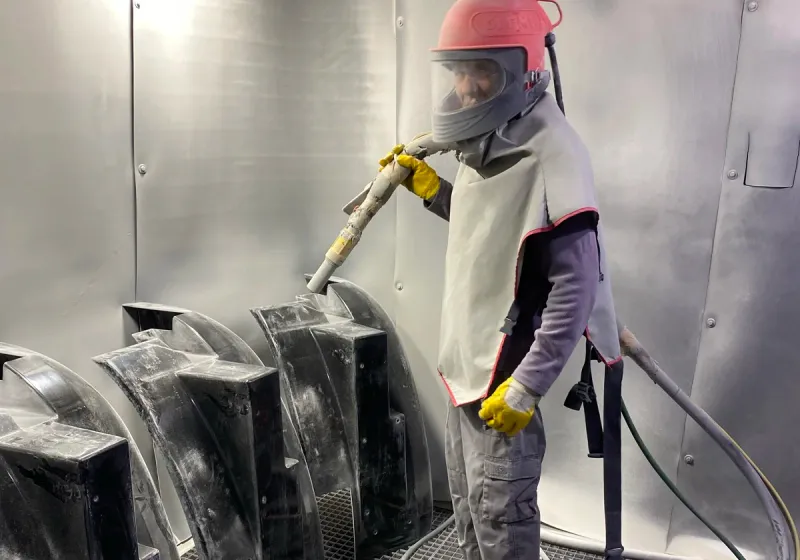
Sandblasting Cabin
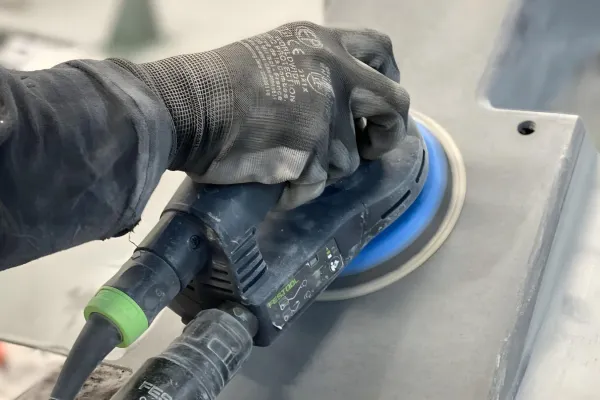
High-capacity surface preparation cabin for abrasive roughening of composite and metal parts. Works with two types of abrasive: aluminium oxide (Al₂O₃) for aggressive roughening and glass bead for fine cleaning. The cyclone dust separator recovers and reuses the media.
- GFRP, CFRP and metal surface preparation for painting
- Removal of mould release and gel coat residues
- Al₂O₃ (80–120 mesh) for aggressive roughening
- Glass bead (100–150 mesh) for fine cleaning
- Cyclone media separation and reuse
- Uniform roughness on large surfaces
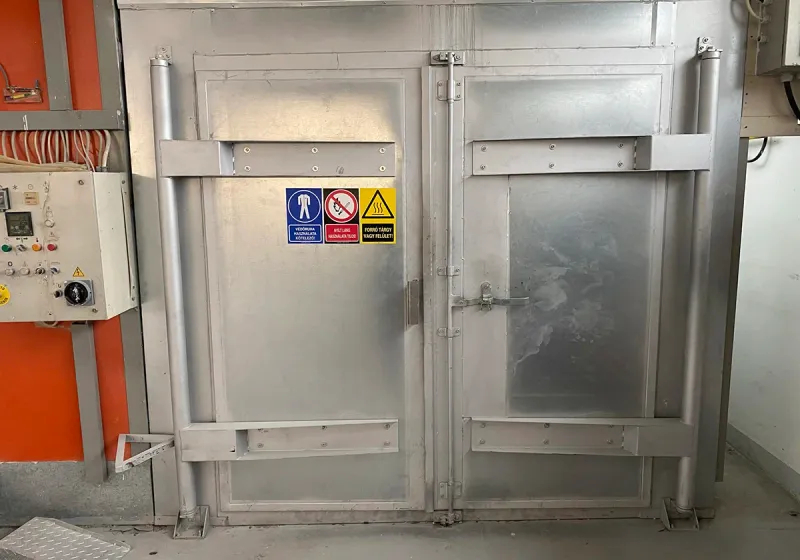
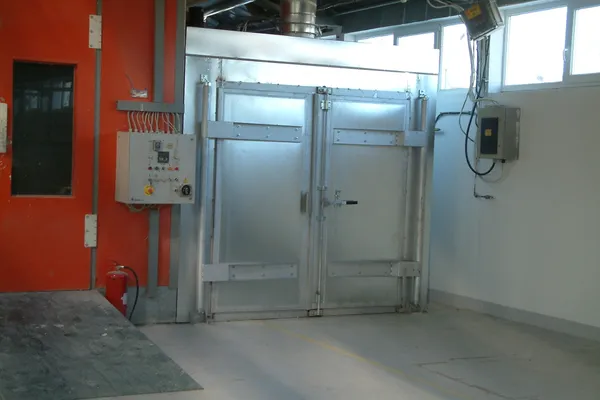
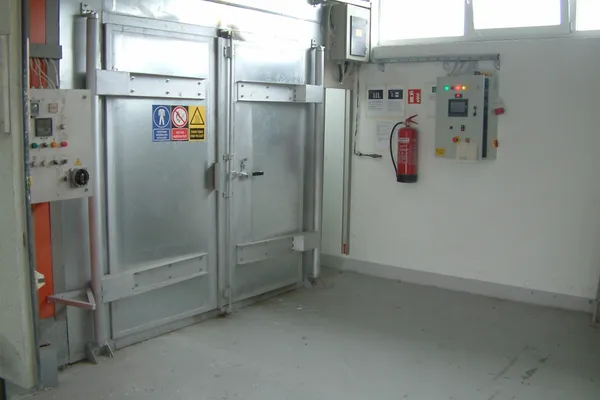
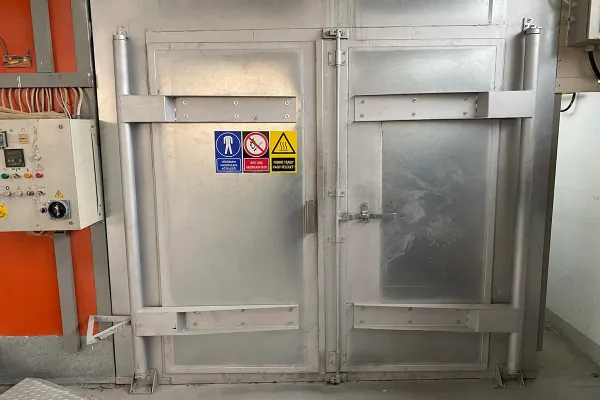
Curing Oven
Electric, air-circulated heating chamber for force-curing painted parts. Controlled temperature (±2°C) ensures complete cross-linking of 2K polyurethane and epoxy systems – maximum hardness is achieved in 45–90 minutes instead of 7 days of air drying.
- 2K PU topcoats: 60°C / 45 min (gloss > 90)
- 2K PU clear coats: 80°C / 60 min (max. hardness)
- Epoxy primers: 80–100°C / 90 min
- Uniform heat distribution with air circulation system
- Continuous VOC gas removal
- Fast cycle time for large series
Curing Oven – Rapid Force-Curing
In the curing oven, we force-cure 2K paint systems at 40–100°C in 45–90 minutes. This ensures complete cross-linking – maximum hardness, chemical resistance and gloss values of the paint layer.
Why Carbon Composites' paint shop?
-
Vertical integration
Painting is not an outsourced step – production, trimming and painting all happen under one roof. RTM or PU-RIM parts go directly from trimming to the spray booth. No transport time, no coordination issues.
-
OEM references and colour matching
VW, MAN, Daimler-level colour matching and surface quality. We verify colour matching with a spectrophotometer – measurement report with every part. Class A surface quality.
-
Material-specific know-how
Every polymer (GRP, CRP, PUR) requires different pre-treatment. We know how to handle different surfaces, which primer, paint and clear coat to use for optimal adhesion and durability.
-
Fast turnaround
Parts can be painted, assembled and shipped within 2–3 days of production. Full vertical integration: tooling → production → trimming → painting → assembly.
-
Certifications and audits
ISO 9001:2015 quality management system, EN 45545 railway fire protection (HL2 and HL3 levels), customer-specific audits (VW, MAN, Daimler). Documented quality.
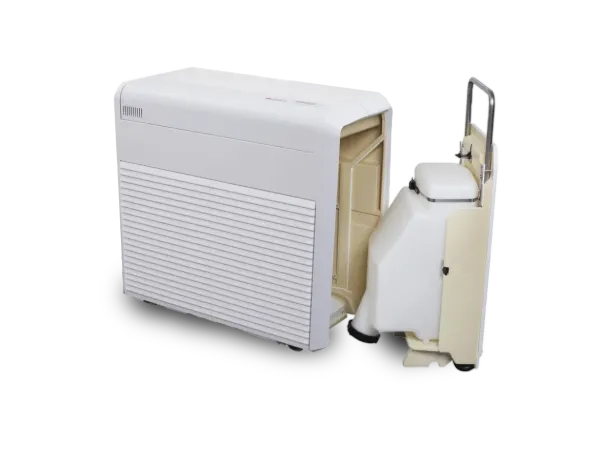
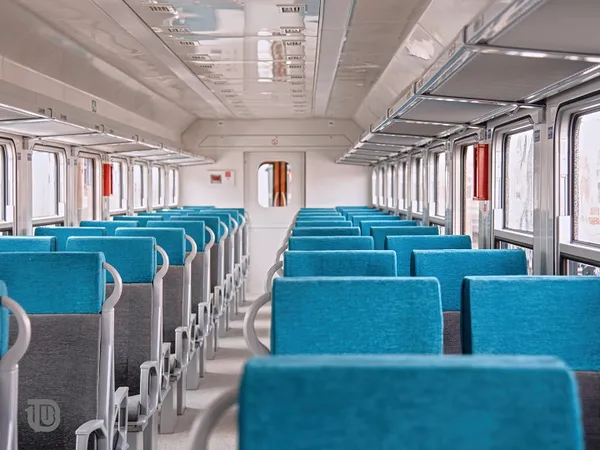
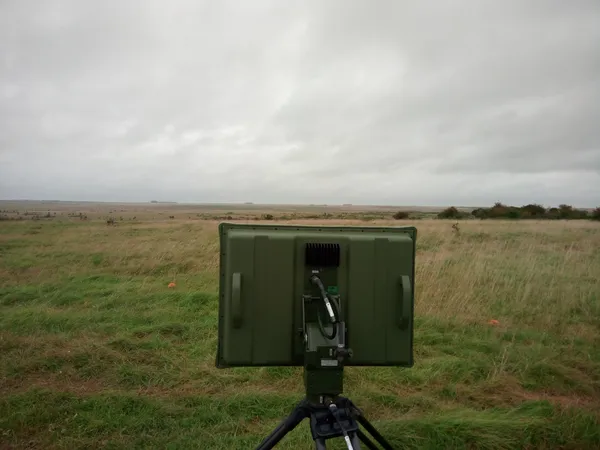
Featured Painting Projects
Frequently asked questions about industrial painting and surface finishing
Class A surface quality is the automotive industry's highest surface standard, meaning a perfectly smooth, defect-free surface that can be mounted directly on the body. We use a four-layer coating system: adhesion primer, filler primer, colour base coat and protective clear coat. The process is verified with a BYK Gardner spectrophotometer at ΔE < 1.0 colour matching accuracy.
We work in RAL, NCS, Pantone and any custom manufacturer-specific colour codes. Carbon Composites' colour lab prepares an exact formulation for every order, including VW, MAN and Mercedes OEM-specification metallic and pearlescent effects.
Our dust-free, climate-controlled spray booths accept parts up to 4000 × 2000 × 1500 mm. This covers most automotive body elements, railway panels and industrial machine housings. We have 2 dedicated spray booths.
In our curing oven, we force-cure 2K paint systems at 40–100°C in 45–90 minutes. This ensures complete cross-linking – maximum hardness, chemical resistance and gloss values. Without heat treatment, air curing would take 7 days and final properties could not be guaranteed.
We offer conductive coatings for EMC shielding (aerospace, medical), flame-retardant coatings to railway EN 45545 standards, anti-slip coatings for walkway surfaces, soft-touch coatings for interiors, and textured finishes (textured, matt, satin).
Different polymers (polyurethane, polyester, epoxy, ABS) have varying surface energies, adhesion properties and heat tolerances. Unlike metals, plastics are flexible, requiring special flexible paint systems. Pre-treatment (degreasing, grit blasting, adhesion primer) varies by material type, and drying temperature must be matched to the part material.
Every batch is checked with a BYK Gardner spectrophotometer (ΔE < 1.0 colour matching). Painting parameters (layer thickness, drying temperature, time) are documented and reproduced. Our ISO 9001 quality management system and VW Group qualified supplier status guarantee consistent quality.