

The Art of Final Touches
In composite part manufacturing, trimming and mechanical processing is the critical step that transforms the raw, as-moulded product into a finished, installation-ready component. At Carbon Composites Ltd., we employ a combination of the most advanced cutting technologies to ensure every part fits its intended position perfectly.
Cutting composite materials presents special challenges compared to conventional metalworking. Fibre orientation, layer count and matrix material type all influence the optimal cutting strategy. With incorrect parameters, delamination, fibre pull-out or edge chipping can occur – all unacceptable in automotive or aerospace applications.
On our production lines, CNC-controlled cutting equipment and six-axis industrial robot cells operate. The robots can cut along complex spatial contours while the tool always contacts the material at the optimal angle. Programmable paths ensure reproducibility and consistent quality in series production.
Our capacities
Trimming Technology
For information on cutting parameters (CFRP/GFRP), delamination prevention, robotic trimming cells, edge quality inspection and dust management, see the trimming technology guide.
Trimming is the critical middle step in our production chain. Semi-finished parts from the RTM mould and PU-RIM products arrive here for contour cutting, drilling and deburring. Processed parts move on to the paint shop, then after assembly they are delivered ready for installation.
Certifications and Standards
- ISO 9001:2015: Quality management system
- EN 45545: Railway vehicle fire protection (HL2 and HL3 levels)
- Customer-specific audits (VW, MAN, Daimler)
Machine Park and Technology
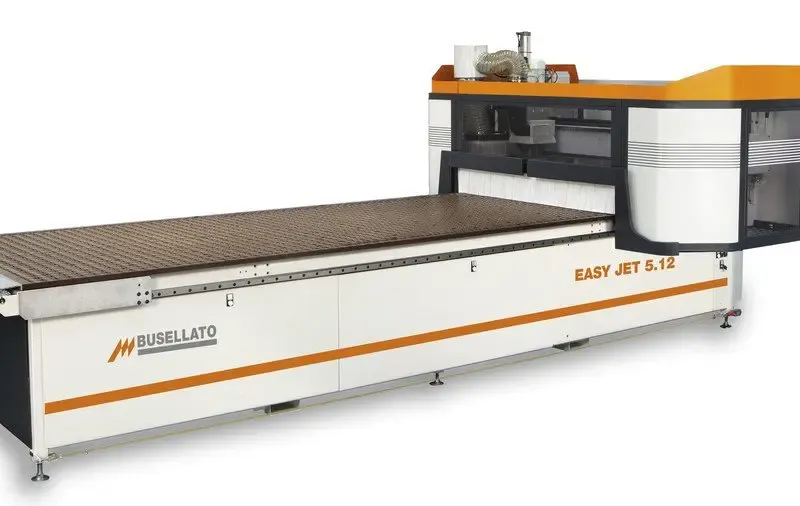
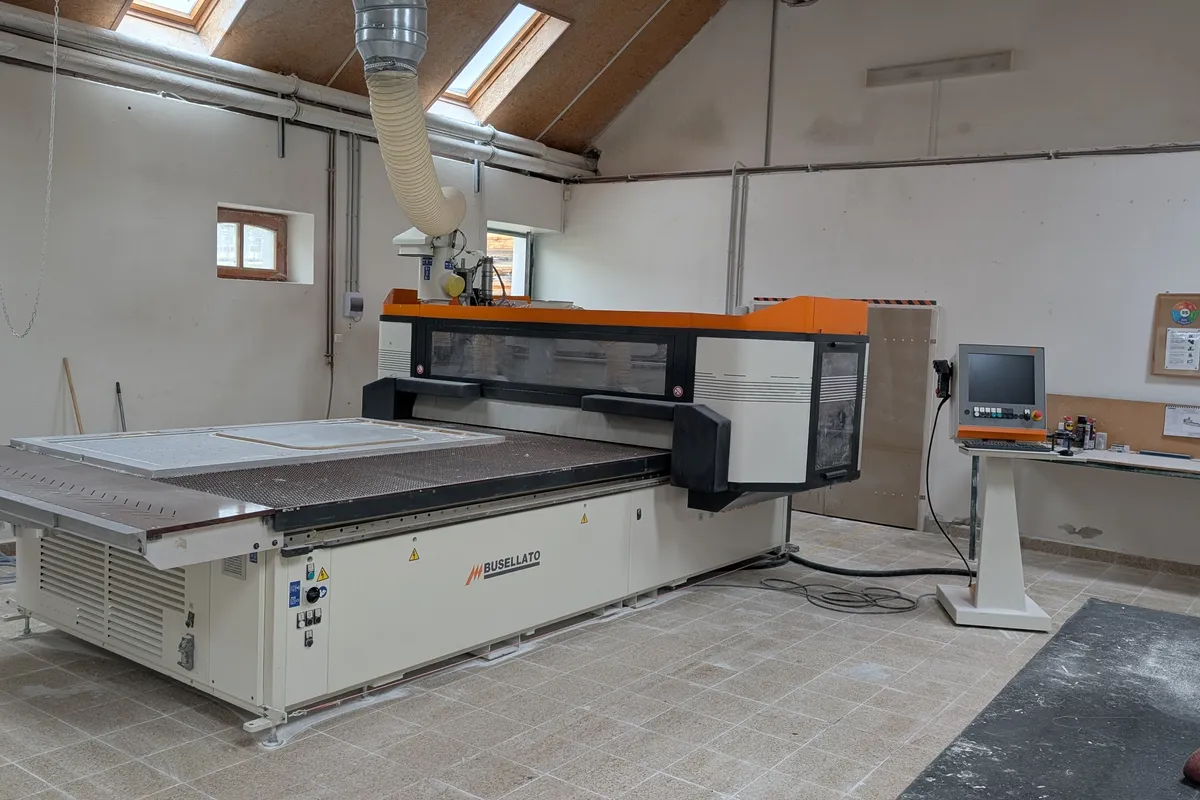
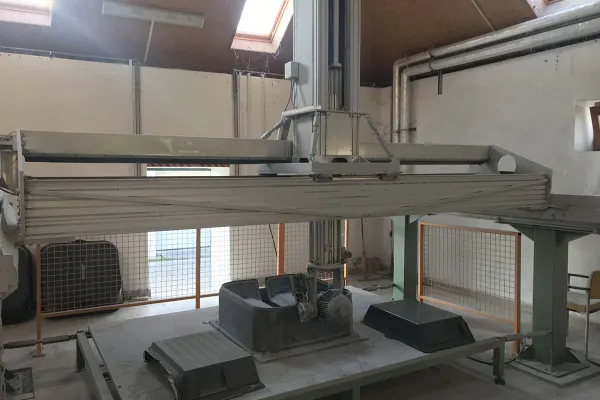
Busellato Easy Jet 5.12
Italian-made 3-axis CNC router with moving-beam design. Welded steel frame, interferometric laser calibration, vacuum table clamping with configurable zones.
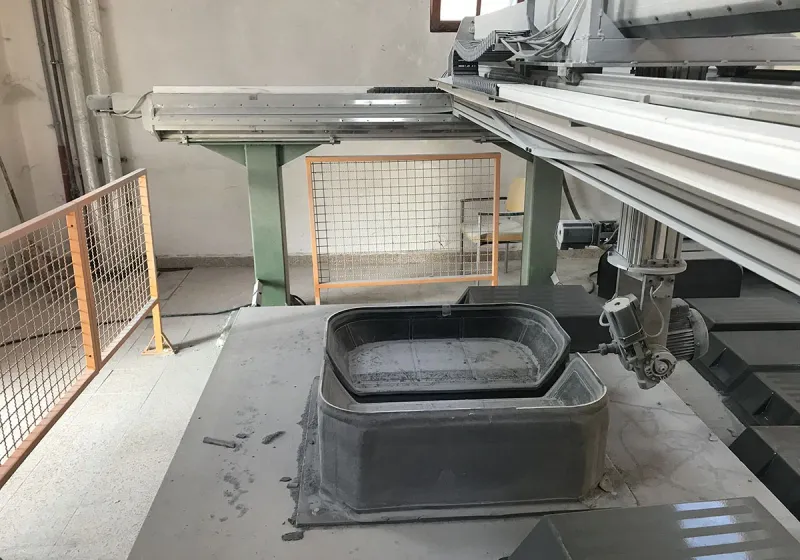
Power Control CNC Trimmer
Compact Hungarian-made CNC trimmer for rapid processing of smaller composite and plastic parts. Complements the Busellato with shorter cycle times.
Robotic Trimming – Series Production Example
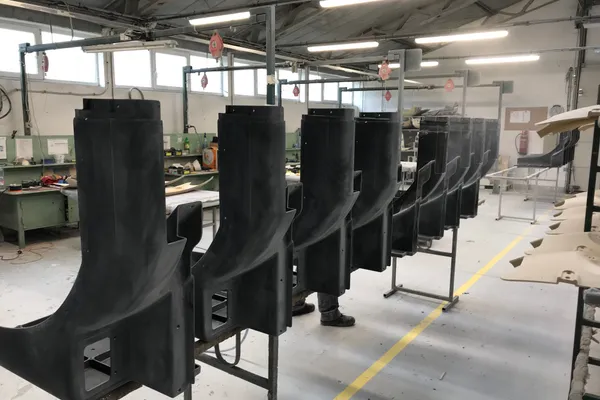
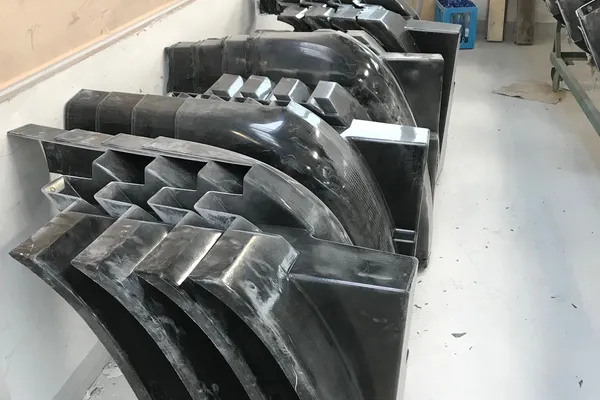
Six-axis robot cells work along complex spatial contours with minimal changeover time. The images below show MAN mudguard series production – parts manufactured with RTM technology proceed to painting and assembly after trimming.
Why Carbon Composites for trimming?
-
30+ years of composite machining experience
We have been working with carbon and glass fibre materials since 1992. We know how to prevent delamination, fibre pull-out and edge chipping. Dedicated composite tools and optimised cutting parameters.
-
Busellato Easy Jet 5.12 CNC router
1524×3658 mm work area, ±0.05 mm accuracy, 24,000 RPM spindle. Optimal for large panels and automotive parts. Diamond-coated (PCD) tools for long service life.
-
Vertical integration
Trimming is not an outsourced step – RTM or PU-RIM parts go directly from production to CNC trimming, then to the paint shop. No transport time, no coordination issues.
-
Robotic machining for complex contours
Six-axis industrial robot cells work along complex spatial contours with minimal changeover time. Programmable paths ensure reproducibility in series production.
-
Environmentally friendly production
HEPA-filtered air purification systems, enclosed extraction cabins. Carbon fibre waste is selectively collected and recycled as composite filler material.
Featured Trimming Projects

Frequently asked questions about trimming and mechanical processing
Trimming and mechanical processing is the post-processing step for composite parts: the semi-finished product from the mould is transformed into an installation-ready state through CNC milling, diamond-disc trimming and robotic machining. Carbon Composites achieves ±0.1 mm contour accuracy.
Fibre reinforcement materials (especially carbon fibre) are extremely abrasive and quickly wear out conventional HSS and carbide tools. Diamond-coated (PCD) tools are required for long service life and delamination-free, accurate cutting.
With specialised cutting parameters (low axial force, optimal feed rate, high spindle speed), dedicated composite tools and offline-programmed robot paths. The Busellato Easy Jet 5.12 operates at ±0.05 mm accuracy with a 24,000 RPM spindle.
The Busellato Easy Jet 5.12 CNC router has a 1524×3658 mm work area for large panels. The Power Control compact CNC trimmer handles rapid processing of smaller parts. We work up to 10 mm material thickness.
Cutting operations are performed in enclosed cabins with extraction. HEPA-filtered air purification systems ensure proper air quality. Carbon fibre waste is selectively collected and recycled as composite filler material.
CNC trimming (Busellato Easy Jet 5.12) is optimal for flat or slightly curved panels at ±0.05 mm accuracy. The six-axis industrial robot works along complex spatial contours, for example trimming deep-drawn body elements where the tool must follow the surface at varying angles.
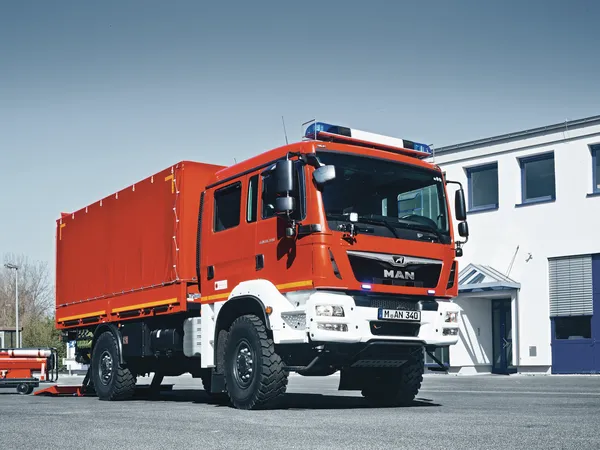
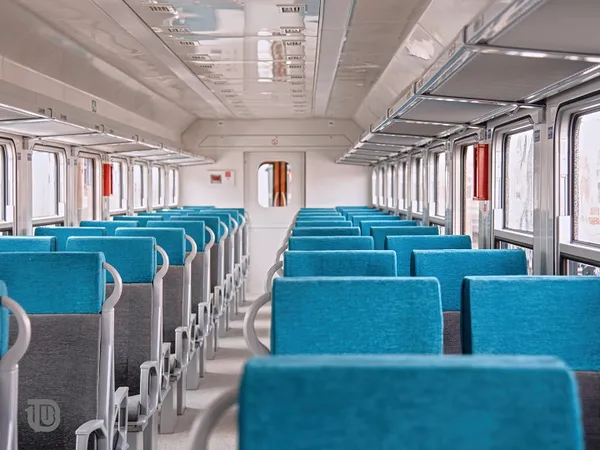
Automotive composite panels (MAN mudguards, VW Amarok hardtop), railway panel elements, PU-RIM parts, medical device housings and industrial machine covers. The two-machine setup (Busellato + Power Control) provides the optimal solution for every part size.